Here is exactly how every ONT airport pickup goes for a large group without a bus: half the party flies Delta and lands at Terminal 2. The other half booked Southwest and touches down at Terminal 4. Both terminals are separate buildings on East Airport Drive — Terminal 2 at 2500 E Airport Drive, Terminal 4 at 2900 E Airport Drive — and now your 24-person group is on two different curbs, in two different rideshare queues, texting each other across 400 feet of airport loop road while bags stack up at two different carousels.
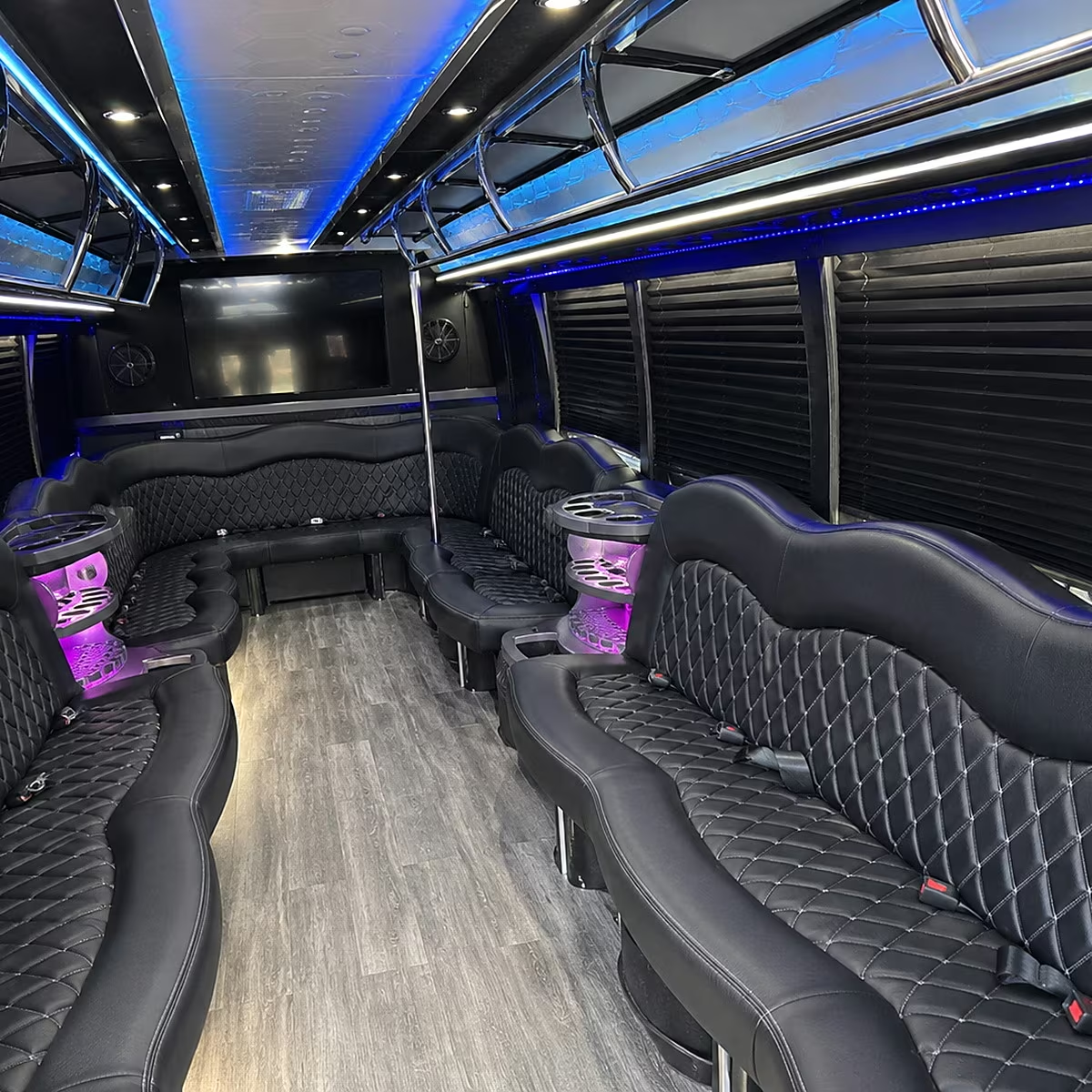
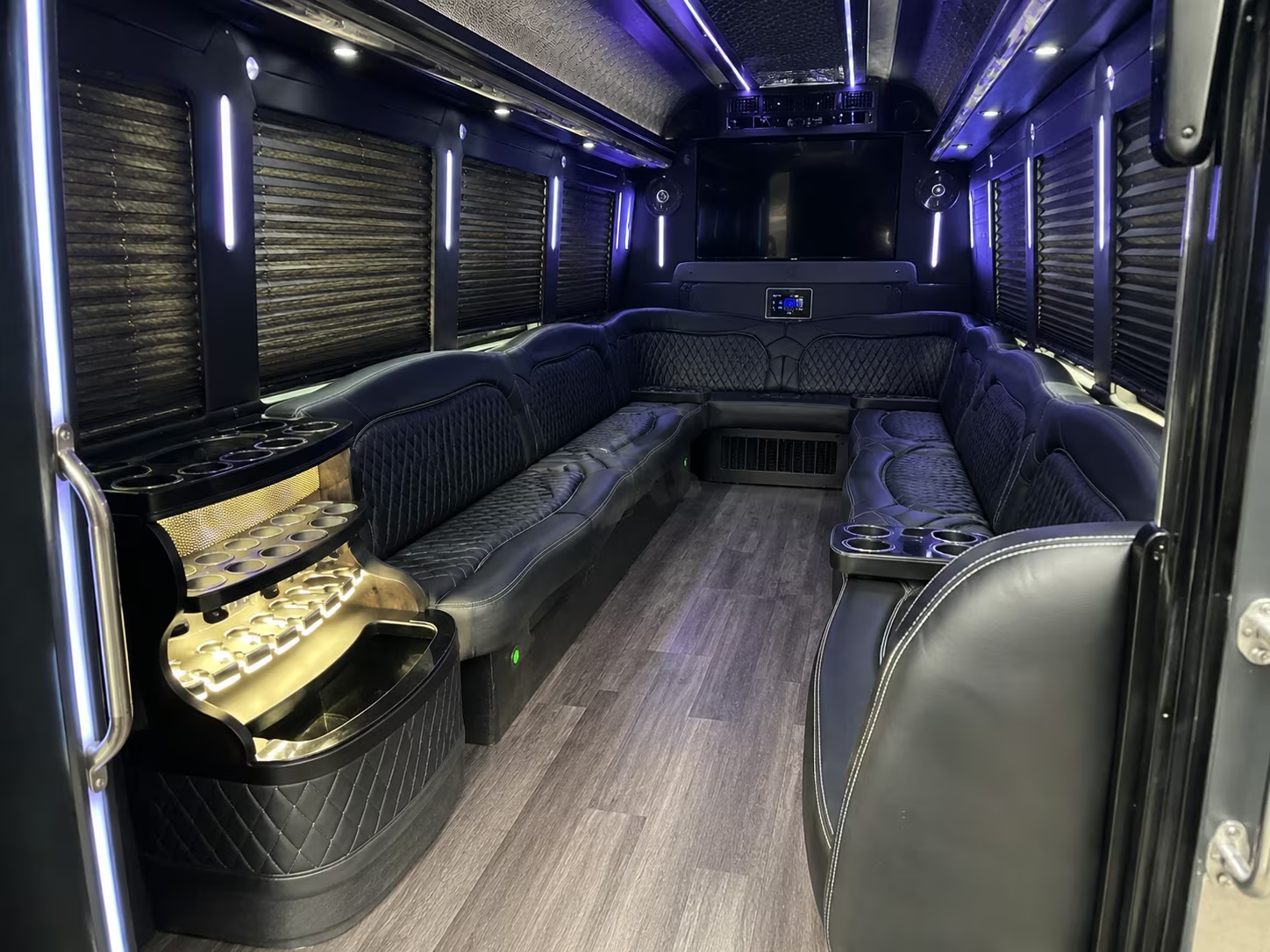
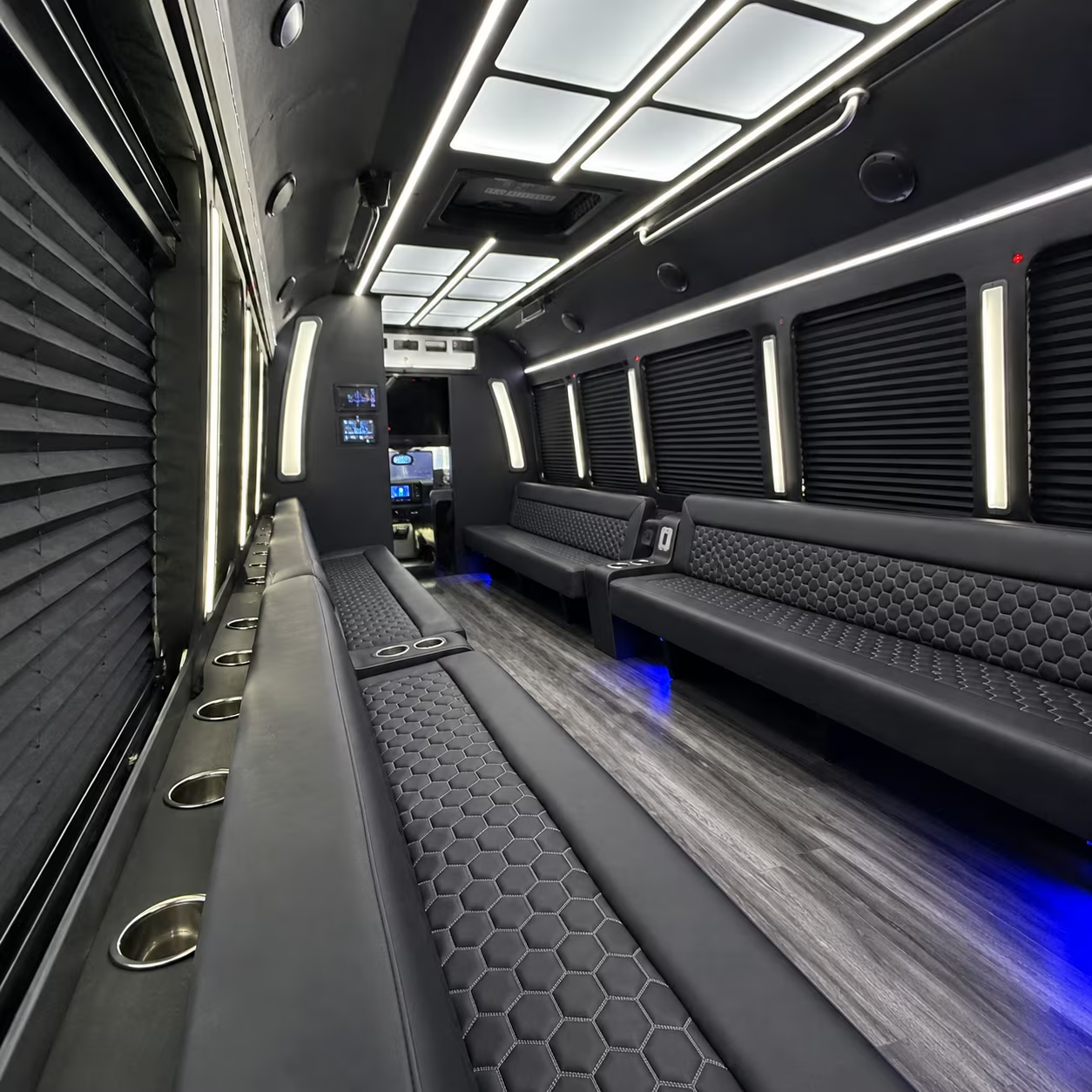
Renting a charter bus or party bus to Ontario International Airport is the answer: one vehicle loops both terminals, picks up every piece of luggage, and delivers everyone to the hotel on a single, predictable schedule.
Ontario International Airport (ONT) is the Inland Empire's primary commercial airport, positioned right at the intersection of I-10, I-15, and SR-60 — and it's one of the fastest-growing airports in Southern California, expecting over 2.2 million passengers in summer 2026. The two-terminal layout at ONT means any group traveling on mixed itineraries faces a real coordination problem that rideshare apps don't cleanly solve. This guide walks you through exactly how a bus works at ONT: which airline lands at which terminal, where the bus picks up, what the cell phone waiting lot at 1940 E Moore Way actually does and doesn't do, how to run the luggage math before you pick a vehicle, and how to build the right buffer into your timing when arrivals are staggered.
For fast pricing, call 909-966-8200 or use the online quote form — either way you'll have numbers in under a minute.
Charter Bus & Party Bus Drop-Off and Pickup at Ontario International Airport
At ONT, departing passengers are dropped off at the upper (departures) level curbside at each terminal — Terminal 2 for Alaska, Delta, United, and their co-terminals, Terminal 4 for American, Southwest, and theirs. Arriving passengers collect bags on the lower (arrivals) level and step outside to the curbside pickup area directly below departures. All commercial ground transportation — charter buses, party buses, minibuses, and Sprinter vans — must hold an Ontario International Airport ground transportation permit or a pre-arranged Trip Ticket before conducting business at the curb.
The airport's ground transportation office manages TCP (Transportation Charter Party) carrier licenses for every vehicle picking up or dropping off passengers on ONT property; if you find your provider through Partybusontario.net, they already handle this before your trip date. There is no dedicated bus staging lot separate from the terminal curbs — a charter bus picks up curbside at Terminal 2, then loops around East Airport Drive to Terminal 4 for a second pickup wave if your group has arrivals at both buildings.
One important logistics note: a 45-foot charter bus on the departures level works best with a quick, efficient load — groups should consolidate bags and have everyone ready at curbside before the bus pulls in, since airport curb stops at ONT are time-controlled. For the arrivals-level pickup, the same rule applies: the whole group should be assembled with luggage before the bus arrives. Neither terminal has a designated commercial staging lot where the bus can idle for 20 minutes while guests filter out of baggage claim.
The practical move is to communicate a clear meeting point inside the terminal — Carousel 2 in T2, for example, or the T4 lower exit nearest your carousel — before anyone pulls out a phone to call for the bus. See the Ontario airport transportation page for more on building that pickup plan.
Terminal 2 vs. Terminal 4: Where Your Group Lands at ONT
The single most important planning detail for any group flying into Ontario International Airport is confirming which terminal each traveler arrives at before the trip, not from the parking lot. The airport skips Terminals 1 and 3 entirely — ONT's original Terminal 1 closed years ago and Terminal 3 was never built — so the two operating terminals have no sequential logic. You cannot assume Terminal 4 is "farther" or newer or higher-volume.
What matters is the airline on the boarding pass.
| Terminal | Address | Gates | Airlines | Baggage Carousels |
|---|---|---|---|---|
| Terminal 2 | 2500 E Airport Drive | 201–212 (12 gates) | Alaska Airlines, Avianca, China Airlines, Delta Air Lines, Frontier Airlines, United Airlines, Volaris | 2 carousels, lower level |
| Terminal 4 | 2900 E Airport Drive | 401–414 (14 gates) | American Airlines, JetBlue, Southwest Airlines, Starlux Airlines, Hawaiian Airlines | 3 carousels, lower level |
| International Arrivals Terminal | Separate building, Lot 1 area | 2 arrival-only gates | Customs/FIS processing; passengers proceed to T2 or T4 for baggage | Baggage in T2 or T4 |
A few points worth emphasizing. First: terminal assignments can change when airlines adjust their fleets or schedules, so always check your boarding pass rather than assuming based on past trips. Second: international arrivals clear customs at the separate International Arrivals facility (opened in 2016 as part of the airport's post-LAWA independent era), then proceed to T2 or T4 for their checked baggage — so guests clearing customs are not in the same building as guests arriving domestically, even if they were on the same aircraft.
Third: the T2 and T4 buildings are connected by a covered landside pedestrian walkway, but that walkway is pre-security only. Once through customs or security, there is no airside connection between the terminals.
Why does this matter for your bus? It determines whether your group has one pickup stop or two. If every traveler is on Alaska or Delta, they all land at T2, and the bus makes one stop.
If the group is split — say, eight colleagues flew United from SFO (T2) and six flew Southwest from LAS (T4) — the bus needs to plan a loop. That's completely workable, and this guide explains how to build that itinerary in the section on split arrivals below.
The Split Arrival Problem at ONT and How a Bus Solves It
Most groups booking an ONT airport charter bus rental are not arriving on a single nonstop flight. Corporate travel groups book the cheapest available fares across multiple carriers. Wedding parties fly in from three different cities over two days.
Conference delegations connect through Denver on United and Dallas on American — two different terminals. This is the norm at ONT, not the exception.
Here is what the split arrival looks like without a bus: eight guests arrive at T2, request four Ubers, and head to the hotel. Six guests arrive at T4 thirty minutes later, request three more Ubers. Two guests connecting from international clear customs and emerge at T2's arrivals curb at a different time altogether, request two more Ubers.
Total: nine separate rideshare trips, none coordinated, all paying surge pricing if the arrivals cluster around 5–7 PM. Luggage goes in trunks instead of undercarriage bays. Nobody is at the hotel at the same time for a group dinner at 7:00 PM.
Here is what it looks like with a charter bus or minibus rental: one vehicle is already at the airport. It pulls to T4 for the Southwest arrivals first, holds at the terminal while bags are loaded, then loops the short stretch of East Airport Drive to T2 for the United arrivals. If the international guests are still in customs, the bus can park in Lot 3 (between the terminals, a short wait) until they emerge.
One vehicle. One final headcount. One departure for the hotel.
That's the version of this trip that actually works.
The key to building a clean split-arrival pickup: assign one person in each terminal group to be the contact — the first person out of baggage claim — and have them signal the coordinator when the group is assembled and rolling luggage out the lower-level doors. The bus then times its pulls to each curb around those signals rather than trying to nail a fixed clock time to a connecting flight. Communicate this plan when requesting your quote so the timing structure is clear.
The Cell Phone Waiting Lot at 1940 E Moore Way: What It Actually Handles
The cell phone waiting lot at 1940 E Moore Way — just off the airport loop before Terminal 2 — has 35 regular spaces and 3 ADA spaces and is free with a one-hour maximum stay. For a couple waiting to pick up one or two passengers from a domestic flight, this is the right tool. You watch the flight land, pull into the lot, wait for a text that bags are in hand, then pull around to the arrivals curb in about two minutes.
For a group pickup, the cell phone lot has real limits. At 35 spaces it fills up quickly on busy travel days, and the one-hour maximum enforces its purpose as a staging area — not a waiting lot for a charter bus managing staggered arrivals across two terminals. More importantly, a 40- to 56-foot charter bus or even a 35-passenger minibus is not designed to idle in a 35-space lot.
Commercial vehicles operating at ONT use the terminal curbs and coordinated arrival timing, not the cell phone lot. That lot is for personal vehicles picking up one or two people from a known, imminent flight — and it does that job well. For a group of 20-plus arriving on two different terminals with bags, it's the wrong tool entirely.
For verified information on the cell phone lot rules, the official ONT airport website at flyontario.com maintains current hours, space counts, and any changes to the waiting lot policy.
ONT Parking Costs: The Math That Pushes Groups to a Bus
Parking at Ontario International Airport ranges from $13 to $38 per day depending on lot and type, with rates that increased on July 1, 2025. Here is how the six lots break down:
| Lot | Daily Rate (approx.) | Notes |
|---|---|---|
| Lot 1 | Hourly only | Opened October 2025; not pre-bookable; serves International Arrivals Terminal |
| Lots 2 & 4 | ~$24–$30/day | General and premium options near T2 and T4 respectively; EV charging available |
| Lot 3 | ~$16–$20/day | Between the terminals; flat-rate daily, walkable to both T2 and T4 |
| Lots 5 & 6 | ~$13–$18/day | Economy lots; free courtesy shuttle to terminals runs every 5–15 min |
| Valet | ~$38/day | Curbside at T2 and T4 departures level |
Run the math on a group trip. A 20-person sales team flies to a three-day conference and everyone drives their own car to ONT. At Lot 3 at roughly $18/day for three days, each car costs about $54.
If most people drive alone, that's 20 cars × $54 = $1,080 in parking before anyone boards the plane — plus 20 cars being coordinated at departures curb on the way in and at the arrivals curb on the way back. A 20-to-35-passenger minibus from Ontario handles the whole group in one vehicle: one parking arrangement (the bus doesn't park — it drops and picks up), one coordinated departure, and $1,080 that stays in the travel budget. For longer trips of five days or a week, the math tips even further.
Check current ONT parking rates on the official airport site before your trip, since lot availability and rates change by season.
Pre-booking online through booking.flyontario.com typically saves $2–$5 per day on self-parking lots. A promo code DECADE is valid through November 1, 2026 for an additional 10% off the regular pre-book discount in Lots 3, 5, and 6. For trips where parking makes more sense than a bus — very small groups, very short stays — the pre-book route is worth it.
For groups of 15 or more, one quote call to 909-966-8200 usually clarifies which option makes more financial sense.
Luggage Math: What Size Bus Does Your ONT Group Actually Need?
The most common booking mistake for airport runs is sizing the bus for the passenger count without accounting for checked bags. A 20-person group traveling to a three-day conference likely has 20 carry-ons and 20 checked bags — 40 pieces of luggage. A Sprinter van seats up to 12 and fits maybe 10 rolling suitcases in its cargo area.
That doesn't work for 20 people with full luggage. Minibuses have overhead storage but limited underfloor space. A charter bus has deep undercarriage bays built for exactly this — bags go below, passengers go above, and the vehicle isn't overstuffed before it leaves the curb.
| Vehicle | Passengers | Luggage Capacity | Best ONT Use Case |
|---|---|---|---|
| Sprinter van | Up to ~12 | Modest — carry-ons plus 8–10 checked bags | Small exec groups, light luggage, one-terminal pickup |
| 14-passenger Sprinter limo | Up to ~14 | Modest — best for light packing or 1–2 bags per person | VIP transfers, wedding party arrivals, anniversary trips |
| 15–35 passenger minibus | 15–35 | Overhead bins plus limited underfloor; better for carry-on-only travel | Corporate groups, school trips, short domestic run |
| 40–56 passenger charter bus | Up to 56 | Excellent — deep undercarriage bays hold 40+ checked bags | Large groups with full luggage, multi-terminal split arrivals, international travelers |
The rule of thumb for airport runs: if more than half the group has a checked bag, step up one vehicle size from what your passenger count suggests. A 25-person group with one carry-on and one checked bag each is really a 25-person group with 50 pieces of luggage — that's a charter bus job, not a minibus job. International arrivals typically add even more luggage volume, since longer trips mean larger bags.
When requesting a quote, share your headcount, your trip length (which predicts bag size), and whether anyone is connecting internationally — those three details produce a more accurate vehicle recommendation than headcount alone.
Browse the full vehicle lineup to compare options side by side, or call 909-966-8200 and share your trip details for a recommendation tailored to your group's actual luggage situation.
Getting to Ontario International Airport: Routes, Drive Times, and What I-10 Does on Weekday Afternoons
ONT sits at the intersection of three major freeways: Interstate 10 (east-west, connecting to downtown LA westbound and Palm Springs eastbound), Interstate 15 (north-south, connecting to Las Vegas northbound and San Diego southbound), and State Route 60 (connecting to Pomona and the eastern San Gabriel Valley). The airport entrance is off East Airport Drive, accessible from Haven Avenue and Vineyard Avenue interchanges on I-10, and from Mission Boulevard on I-15.
| From… | Approx. Distance | Off-Peak Drive Time | Peak Caution |
|---|---|---|---|
| Downtown Los Angeles | ~35 miles | 45–60 min | I-10 east clogs 4–7 PM; add 30–45 min |
| Pasadena / San Gabriel Valley | ~25 miles | 35–45 min | SR-60 to I-10 interchange heavy PM |
| Rancho Cucamonga | ~9 miles | 12–18 min | Minimal congestion; one of the cleanest approaches |
| Downtown Ontario | ~2 miles | 5–10 min | Light; Airport Drive access straightforward |
| San Bernardino | ~18 miles | 20–30 min | I-10 westbound moderate AM traffic |
| Palm Springs | ~65 miles | 65–80 min | I-10 westbound can back up at Beaumont summit |
The critical timing window for ONT airport runs: westbound I-10 and eastbound I-10 both back up from roughly 4:00–7:00 PM on weekdays, and Friday afternoons are the worst of the week. Groups flying out for a long weekend or conference should build at least 30 extra minutes into their departure buffer if the airport pickup is in the late afternoon. Groups flying in during that window face the same I-10 crawl on the return trip to LA or the San Gabriel Valley.
An Ontario airport charter bus rental handles all of this from the front — the bus accounts for traffic conditions on the route, and the group isn't watching the clock while someone else navigates the Pomona interchange.
Building Buffer for Staggered and Split Arrivals at ONT
The trickiest airport pickup is the one where your group is arriving in waves — some people landing at 3:30 PM, others at 5:15 PM, and a connecting international flight clearing customs around 6:00 PM. Without a bus, that's three separate Uber surges over three hours. With a bus, the timing structure is something you build into the booking: one vehicle positioned at the airport with flexible staging between arrival waves.
Here's how to build that buffer correctly:
Step one: Map every flight, every terminal, every arrival time. Before you finalize any bus booking, list every traveler's flight number, airline, scheduled arrival, and terminal assignment. United lands at T2; Southwest lands at T4; American lands at T4; Alaska lands at T2.
International arrivals clear customs at the International Arrivals facility, then pick up bags at T2 or T4 depending on their airline's domestic connection. That spreadsheet becomes your pickup sequence.
Step two: Build 45 minutes of buffer around every scheduled arrival. A flight arriving at 4:30 PM might taxi for 20 minutes, deplane for 10 minutes, and have a 15-minute wait at baggage claim. Your bus shouldn't be at the curb at 4:30 PM.
Target 5:15 PM for a 4:30 PM arrival — that's a reasonable pull-up time for most domestic flights. For international arrivals clearing customs, build 75–90 minutes from wheels-down. ONT is not a massive international hub, but customs processing still takes time, especially if the flight is large.
Step three: Use the Lot 3 hold for multi-wave pickups. Between T2 at 2500 E Airport Drive and T4 at 2900 E Airport Drive sits Lot 3 — the flat-rate daily lot between the two terminals. A charter bus staging between pickup waves doesn't need to idle at a curb or circle the airport loop.
It can position in Lot 3 temporarily while waiting for the second wave to clear baggage claim. This is much cleaner than a bus circling East Airport Drive repeatedly while your group texts from inside T4.
Step four: Assign a group coordinator at each terminal. For split-terminal pickups, designate one person in each terminal group to be the communication lead. That person texts the central coordinator (who is in contact with the bus) when the group is assembled, bags are in hand, and they're heading for the lower-level exit.
The bus then times the curb pull to each terminal around those live signals — not around a scheduled arrival time that a delayed connection already broke.
This is the version of an Ontario airport charter bus run that actually functions. The chaos version — everyone texting from different luggage carousels, no designated lead, three Uber estimates open on four phones simultaneously — is why groups end up at the hotel 90 minutes later than expected. Planning the pickup sequence in advance, before the first flight lands, is the whole game.
Ontario Airport Transportation Options Compared
Partybusontario.net connects you to a large network of bus companies serving Ontario — it's not the right answer for everyone, and it's worth being straight about that. Here is how the main ONT transportation options compare for group travel:
| Option | Cost Shape | Group Stays Together? | Luggage Handling | Split-Terminal Capable? | Best Group Size |
|---|---|---|---|---|---|
| Charter bus or minibus rental | One flat rate, split by the group | Yes — everyone in one vehicle | Excellent — undercarriage bays for full bags | Yes — loops both terminals | 15–56 |
| Rideshare (Uber/Lyft) | Per car each way, surge after evening flights | No — multiple cars, multiple ETAs | Trunk only, no bags in aisle | Sort of — multiple cars at two curbs | 1–4 per car |
| Rental cars | Per car per day + ConRAC shuttle + gas + parking | No — group splits into cars | Trunk only | Each car picks up one terminal | 1–5 per car |
| Omnitrans Route 380 (ONT Connect) | ~$2/person per ride | If on the same bus | Carry-on only; no checked-bag infrastructure | Yes — stops at both T2 and T4 | 1–4 (practical for individuals) |
| Hotel/airport shuttle | Often free; fixed schedule | Only if on the same shuttle run | Limited; designed for carry-on | Usually one terminal per run | Any; not group-coordinated |
Omnitrans Route 380 (ONT Connect) runs non-stop between Ontario International Airport and the Rancho Cucamonga Metrolink station every 35–60 minutes on weekdays and every 60 minutes on weekends, stopping at both Terminal 2 and Terminal 4. At roughly $2 per ride, it's the most affordable ground transportation from the airport for an individual traveling light. For a group of 15 with checked bags, it stops being practical — you'd need multiple buses, each with a schedule that doesn't align to your flight, and bags don't go in the overhead racks.
For groups of 10 or more with luggage, a private Ontario airport charter bus rental is almost always the cleaner math once you factor in the cost of coordination, wait time, and the physical reality of checked bags on public transit.
Rideshare at ONT: Uber and Lyft pick up curbside at the inner curb at Terminals 2 and 4, per Uber's official ONT pickup page. For one or two people without luggage complications, this works fine. For a split-terminal group arriving across two terminals, you're looking at coordinating multiple cars at multiple curbs, with surge pricing likely if your arrivals cluster around 5–7 PM.
Ontario Airport Charter Bus and Party Bus Rental Prices
Bus rental prices for ONT airport runs vary based on vehicle size, how many hours the vehicle is reserved, your pickup location, and the date. To give you an idea of planning ranges: a 15–35 passenger minibus typically runs $200–$275 per hour on weekdays and $200–$275 per hour on weekends, with daily rates from $1,100–$2,150 for full-day service. A 40–56 passenger charter bus runs $200–$350 per hour on either weekday or weekend, with daily rates from $1,350–$2,850.
Those are example ranges to help you plan — the real number for your group depends on your specific itinerary, date, and headcount.
Split it across the group and it shifts the math significantly. A 30-person group sharing a minibus at $225/hour for a 4-hour airport run comes out to $30 per person — comparable to a single Uber ride, but everyone stays together, the bags fit, and there is no surge pricing after a 6 PM landing. See the Ontario party bus prices page for a fuller range breakdown, or call 909-966-8200 any time for an actual quote on your date and group size — pricing comes back in under a minute.
For corporate groups booking regular ONT runs — monthly team travel, conference shuttles, quarterly sales trips — Partybusontario.net connects you to providers in the network that handle recurring contracts as well as one-off trips. See the Ontario corporate event transportation page for more on how recurring airport runs are structured.
Frequently Asked Questions About Renting a Bus to Ontario International Airport
Where exactly does a charter bus or minibus pick up passengers at ONT?
Arrivals-level pickup is curbside at the lower level of each terminal — directly outside baggage claim at Terminal 2 (2500 E Airport Drive) or Terminal 4 (2900 E Airport Drive), depending on which terminal your group arrives at. Commercial vehicles need an ONT ground transportation permit or pre-arranged Trip Ticket to operate at the curb. All pickup is time-coordinated — the bus pulls to the curb when the group is assembled with luggage, not while passengers are still at the carousel.
What's the difference between Terminal 2 and Terminal 4 for a group pickup?
Terminal 2 is at 2500 E Airport Drive (12 gates, numbered 201–212) and serves Alaska, Delta, United, Frontier, Avianca, China Airlines, and Volaris. Terminal 4 is at 2900 E Airport Drive (14 gates, numbered 401–414) and serves American, Southwest, JetBlue, Starlux, and Hawaiian. The two buildings sit on the same one-way loop road and are connected by a covered landside walkway before security, but have separate arrivals curbs, separate baggage claim carousels (T2 has 2, T4 has 3), and separate pickup zones.
A bus handling a split-terminal group loops from one to the other on East Airport Drive — manageable, but requires a staged pickup plan rather than a simultaneous pull.
Can the bus pick up passengers at two different terminals in one run?
Yes. This is one of the most common ONT group pickup scenarios and something providers in the Partybusontario.net network handle regularly. The sequence is typically: pull to T4 for Southwest/American arrivals, load the group and bags, then loop the short distance on East Airport Drive to T2 for the Delta/Alaska arrivals.
If the T2 group isn't ready yet, the bus can stage in Lot 3 — between the two terminals — while waiting. Build this sequence into your quote request so the timing is set correctly from the start.
What is the cell phone waiting lot at 1940 E Moore Way?
The cell phone waiting lot at 1940 E Moore Way is a free, attended-vehicle waiting area with 35 regular spaces and 3 ADA spaces, with a one-hour maximum. It's designed for personal vehicles waiting to pick up one or two passengers from a domestic arrival — you wait there, your traveler texts that bags are in hand, and you pull to the terminal in two minutes. It is not designed for charter buses or large commercial vehicles, and the 1-hour maximum makes it unsuitable for groups managing staggered arrivals across two terminals.
Charter buses stage at the terminal curb or hold temporarily in Lot 3.
How far in advance should I book an Ontario airport bus rental?
For standard group sizes and dates, two to four weeks of lead time is workable. For large groups (30-plus), peak travel seasons (Thanksgiving, holiday weeks, summer), or specific large-vehicle types like a 56-seat charter bus, four to eight weeks out is a safer target. Confirming your flight details before the booking also matters — split-terminal pickups work much better when the vehicle provider knows the exact terminal assignments and arrival times in advance.
Call 909-966-8200 any time to check availability on your date.
Does the bus need a special permit to pick up at ONT?
Yes. All commercial ground transportation operating at Ontario International Airport must hold an ONT Ground Transportation permit or purchase a pre-arranged Trip Ticket for each vehicle. This applies to charter buses, party buses, minibuses, Sprinter vans, and limousines.
Providers in the Partybusontario.net network handle this permit process before your trip — it's not something you arrange separately as the passenger. It does mean you should book through an established provider who has this authorization, not arrange an impromptu pickup with an unauthorized carrier.
Is public transit an option for getting a group to or from ONT?
For individuals, yes. Omnitrans Route 380 (ONT Connect) runs non-stop between ONT's Terminal 2, Terminal 4, and the Rancho Cucamonga Metrolink Station every 35–60 minutes on weekdays and every 60 minutes on weekends, with service from about 4:30 AM to 11:30 PM daily. Metrolink's San Bernardino Line connects Rancho Cucamonga to Los Angeles Union Station.
Omnitrans Route 61 provides broader regional service to Pomona, Ontario, and Fontana. For groups of 10 or more with checked luggage, the transit-plus-rail sequence adds significant coordination complexity and doesn't solve the luggage problem. One charter bus rental handles both.
What's the rental car center at ONT, and is it worth it for groups?
The consolidated Rental Car Center (ConRAC) is at 3450 E Airport Drive, about a 5–10 minute free shuttle ride from the terminals. Ten agencies operate from this facility, and the shuttle runs continuously, day and night. For groups, rental cars add up: each car ties up someone to drive it, its own gas, its own separate parking arrangement, and its own separate navigation to wherever the group is going.
Groups of 10 or more almost always save money and coordination overhead by consolidating into one or two vehicles rather than renting a car per person or per two people.
Book Your Ontario Airport Charter Bus or Party Bus Today
Whether your group is flying in from five different cities on three different airlines, organizing a corporate conference transfer from ONT to downtown Ontario, or managing a split-terminal pickup for a 40-person wedding party arriving over two days — Partybusontario.net makes comparing vehicle options fast and easy. Use the online form to get pricing in under 30 seconds, or call 909-966-8200 any time to talk through your pickup structure with a support team. No account required.
No obligation. Just the right bus for your group, at the right price.
Also planning an event while your group is in the Inland Empire? The guides for Toyota Arena and the Ontario Convention Center cover drop-off, parking, and group logistics at both venues — useful if your ONT arrival is the first stop on a longer itinerary.